Last Updated on October 13, 2026 by Eric
October fishing in Tampa Bay brings together three of our favorite inshore targets: redfish working the flats, snook feeding around shoreline structure, and spotted seatrout holding over grass and sandy potholes. As the bay gradually moves away from summer conditions, anglers can find more opportunities to work shallow water, follow feeding fish, and put artificial lures to use.
At Bag’Em Fishing Charters, we build our Tampa Bay inshore fishing trips around the conditions rather than a fixed list of stops. Some October mornings call for live bait along a mangrove shoreline. Others are better suited to casting a paddletail across a grass edge or presenting a shrimp imitation ahead of a cruising redfish.
The important distinction is that October is a transition, not an instant switch to cool weather. Warm stretches can keep fish in familiar summer locations, while a passing front can change water levels, visibility, and feeding behavior. Staying flexible is what connects the season’s opportunities to a productive day on the water.
What Changes in Tampa Bay During October?
The transition from September fishing in Tampa Bay into October puts more attention on schooling redfish, shallow-water feeding opportunities, and the movement of snook toward protected inshore habitat. Baitfish are still important, but shrimp and crabs also give predators plenty of reasons to work grass, shell, and shoreline edges.
October weather can vary considerably. The National Weather Service identifies mid-September through early October as the wind-down phase of the local summer thunderstorm season, with early cold fronts and tropical systems contributing to that variability. A calm, warm morning and a breezy morning following a front may require very different fishing plans.
| October Condition | What It Means for Fishing | Practical Adjustment |
|---|---|---|
| Gradually cooling water | Grass flats, shoreline edges, and creek approaches become increasingly useful places to look for feeding fish. | Check shallow feeding areas while keeping nearby deeper water in the plan. |
| Redfish schools | Several fish may be concentrated along one stretch of shoreline or a particular flat. | Approach quietly and present the bait ahead of the fish rather than landing it in the middle of the school. |
| Falling water | Fish lose access to the shallowest shoreline cover and reposition along drains and edges. | Work creek mouths, sandy cuts, potholes, and the outside edges of oyster bars. |
| Clear, calm conditions | Fish can be easier to spot but may also detect the boat and unnatural presentations more readily. | Use a quiet approach, controlled casts, and lures that enter the water softly. |
| Wind or a passing front | Water levels, clarity, and the most comfortable fishing areas can change. | Reassess the route, favor suitable protected water, and adjust presentation speed. |
Redfish Are a Major October Target
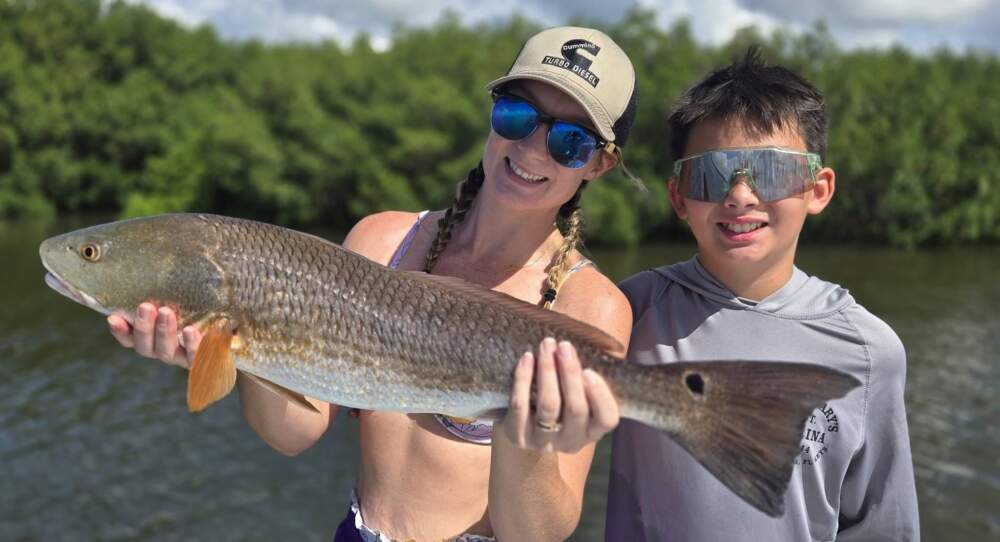
Fall is an important season for redfish fishing in Tampa Bay. Schools can gather along grass flats, mangrove shorelines, oyster edges, and sandy transitions. Finding those fish is only part of the process. Keeping them comfortable enough to feed is just as important.
On higher water, redfish may push close to mangrove roots and shoreline cover. As the water falls, look farther out toward grass edges, shallow depressions, and routes connecting the shoreline to deeper water. Mullet activity can help narrow the search, although a school of mullet is a reason to investigate rather than a guarantee that redfish are present.
Live shrimp, scaled sardines, pinfish, and cut bait all have a place in the October plan. For anglers casting artificials, shrimp imitations, weedless paddletails, and gold spoons offer different ways to cover the same habitat. The right presentation depends on whether the fish are cruising, feeding with their heads down, or holding near cover.
When a school is visible, avoid repeatedly casting directly onto it. Place the bait ahead of the fish and let them reach it. A careful first presentation often gives you a better opportunity than several hurried casts after the school becomes nervous.
Redfish are not limited to one type of prey. Their diet includes fish and invertebrates, which helps explain why both baitfish presentations and crustacean imitations can work. The FWC redfish species profile provides additional background on their feeding and seasonal behavior.
October Snook Fishing: Follow the Current and Cover
October keeps Tampa Bay snook fishing firmly in the picture. Mangrove points, creek entrances, docks, seawalls, and other structure can hold fish wherever moving water delivers food to an ambush position.
As temperatures begin to fall, snook may gradually shift toward creeks, canals, and more protected shorelines. That movement does not happen everywhere at once. During a warm stretch, fish may continue using relatively exposed areas. After a meaningful temperature change, nearby depth and protection become more important places to investigate.
Presentation matters around snook. A bait drifting naturally past the edge of a dock or mangrove point is usually more convincing than one being pulled against the current. With artificials, work the feeding lane beside the cover instead of repeatedly casting beyond it into open water.
Topwater plugs can be useful in lower light, while shrimp imitations, paddletails, and suspending twitchbaits provide options below the surface. Check leaders after contact with rough structure or after landing a fish. Abrasion can weaken an otherwise suitable setup.
Although October falls within Tampa Bay’s current snook harvest season, we encourage catch-and-release fishing. A successful snook trip does not depend on finding a fish that fits the legal harvest slot.
Spotted Seatrout on Grass Flats and Sandy Potholes
For anglers who enjoy covering water, spotted seatrout fishing is a good fit for an October inshore trip. Grass flats, sandy openings, creek approaches, and nearby depth changes give us several types of water to explore.
Do not assume that every trout has moved into the shallowest water simply because the calendar says fall. During warmer conditions, deeper grass and outside edges may still deserve the first look. As conditions change, shallower grass and flats near creek mouths can become more productive.
Live shrimp beneath a popping cork provides a straightforward presentation for newer anglers. Paddletails and suspending twitchbaits let experienced casters search a larger area and adjust the retrieve to the fish. Around grass, keep the lure above the vegetation rather than dragging it through the bottom.
Once a productive section is found, make another controlled pass through it. There is usually more value in carefully working the right depth and bottom type than moving randomly across a large flat. Handle trout gently, support larger fish, and keep release time brief.
Black Drum and Other Inshore Opportunities
Black drum give us another option around oyster beds, dock pilings, bridges, and bottom transitions. Shrimp and pieces of crab presented near the bottom are useful choices when these fish are feeding around shell and structure.
Compared with actively searching for redfish or trout, drum fishing often calls for a slower presentation. Put the bait where a fish can find it and resist the temptation to retrieve it away too quickly.
Jack crevalle and other incidental catches can also add variety while we work the flats and shoreline edges. We keep the day’s priorities tied to the group’s goals, but an unexpected feeding opportunity is worth recognizing rather than ignoring.
Why October Is Worth Considering for Artificial Lure Fishing
Anglers who enjoy making their own casts, reading the water, and triggering a strike should consider our artificial lure fishing charters. October offers opportunities to work several presentations without limiting the entire trip to one species.
A paddletail is useful for searching grass edges and covering water between visible targets. A shrimp imitation can be presented quietly near a tailing redfish or worked beside mangrove cover. A suspending twitchbait gives you a way to pause the lure over sandy openings, while a topwater plug can draw attention when fish are feeding near the surface.
The goal is not to change lures constantly. Start with a presentation suited to the depth, grass coverage, and available bait. Then adjust the retrieve, weight, or profile based on how the fish respond. After a front, that may mean slowing down. When fish are actively chasing bait, a more direct swimming retrieve may be effective.
For a closer look at those presentations, explore our guide to fall artificial lure fishing in Tampa Bay.
Plan Around Water Movement, Not Just Sunrise
Early starts can be valuable in October, particularly during warm weather or when the goal is low-light topwater fishing. They are not the only factor that matters. A useful period of moving water can be more important than arriving at a particular shoreline at first light.
Rising water can open access to shoreline cover. Falling water can make drains, creek mouths, and outside edges more attractive. The best direction depends on the location, so there is no single incoming or outgoing tide that works best across the entire bay.
Wind also deserves attention. Astronomical tide predictions do not account for every change caused by wind, atmospheric pressure, or river flow. NOAA explains this distinction in its overview of water-level and current forecasts. On a shallow-water trip, the water actually present on a flat matters more than assuming the tide chart tells the whole story.
After a cooler night, a shallow area may also become more useful once it has had time to warm. That does not mean every trip should start later. It means we match the route and fishing sequence to the conditions instead of repeating a summer schedule automatically.
Choose the Right October Fishing Trip
Live-Bait Fishing for Families and Mixed Experience Levels
Live-bait trips are a practical choice for families, friends, and groups with different fishing backgrounds. They let us concentrate on positioning, bait presentation, and fighting fish without requiring every guest to be an experienced lure angler.
Tell us whether the priority is learning, targeting a particular species, or enjoying a varied day on the water. Those details help shape the trip more effectively than simply requesting the biggest possible fish.
Artificial Lure Fishing for Anglers Who Want to Cast
Our lure-focused trips are best suited to anglers comfortable making repeated, accurate casts. One to three anglers is the recommended group size for this style of fishing, allowing room to work presentations and respond when a fish appears.
Bringing a preferred setup is welcome, but discuss it with Captain Bucky beforehand so the tackle suits the fishing you have in mind.
October 2026 Fishing Regulations for Tampa Bay
The following recreational harvest summary applies to the Tampa Bay management region for snook, redfish, and spotted seatrout. The flounder closure applies in Florida state waters and federal waters off Florida. Regulations can change, so review the linked FWC rules before your trip.
| Species | October Harvest Status | Size and Daily Limits |
|---|---|---|
| Snook | Open during the September 1 through November 30 fall season. | 28 to 33 inches total length; one fish per person per day. |
| Redfish | Open year-round. | 18 to 27 inches total length; one fish per person per day, with a two-fish vessel limit. |
| Spotted seatrout | Open year-round. | 15 to 19 inches total length; three fish per person per day. One fish over 19 inches may be kept per vessel, included within the bag limit. |
| Flounder | Open October 1 through October 14. Harvest closes October 15 through November 30. | During the open season: 14-inch minimum total length and five fish per person per day. |
Captain and crew may not retain their own bag limits of snook, redfish, or spotted seatrout while on a for-hire trip. The seatrout allowance for a fish over 19 inches is per vessel, not one for every guest aboard.
Legal harvest is only one part of planning a fishing trip. We encourage responsible release practices, and fish outside the applicable harvest limits must be returned to the water.
What to Bring and Where We Meet
We provide fishing gear, tackle, bait, and iced bottled water, and guests are covered under the captain’s fishing license. Bring your preferred snacks and additional drinks, sunscreen, polarized sunglasses, a hat, and a lightweight layer or rain jacket.
Wear suitable non-marking footwear and avoid boots or dark-soled shoes. Keep personal belongings compact, and let us know in advance when children are joining the trip so appropriate safety equipment can be arranged.
Our main launch locations include the Courtney Campbell Causeway Boat Ramp and the Gandy Boulevard Boat Ramp. Captain Bucky confirms the meeting location and start time based on the trip, weather, and fishing conditions. Review our charter FAQs for additional preparation details.
October Tampa Bay Fishing FAQs
Is October a good month for redfish in Tampa Bay?
Yes. October offers opportunities to find redfish around flats, mangrove shorelines, oyster edges, and feeding schools. Success still depends on water levels, bait, weather, and approaching the fish without disturbing them.
Can you catch snook, redfish, and trout on the same trip?
All three are regular targets on our inshore charters, so a Tampa Bay inshore slam is possible. It is a goal rather than a guarantee, and we adjust the plan to the species and locations producing the best opportunities that day.
Is live bait or artificial fishing better in October?
Both can work. Live bait is a versatile choice for mixed-skill groups, while artificial fishing suits anglers who want to make repeated casts and work different presentations. The better choice depends on your experience, preferences, and the conditions.
Does a cold front ruin an October fishing trip?
Not necessarily. A front may change where fish hold and how they respond, but strong wind or unsafe conditions can affect whether a trip should proceed. Protected water, nearby depth, and slower presentations may become more important when conditions change.
Book Your October Tampa Bay Fishing Charter
October gives us several ways to approach a day on Tampa Bay, from presenting live bait beside mangroves to casting lures across grass flats and sight-fishing for redfish. The best trip starts with choosing an approach that fits your group and leaving room to respond to the water.
Join Captain Bucky and Bag’Em Fishing Charters for a fall inshore trip built around your experience level and fishing goals.
Plan your October day on the water: Reserve your Tampa Bay fishing charter online, call or text 407-977-7650, or contact Captain Bucky to discuss your group, preferred fishing style, and available dates.